

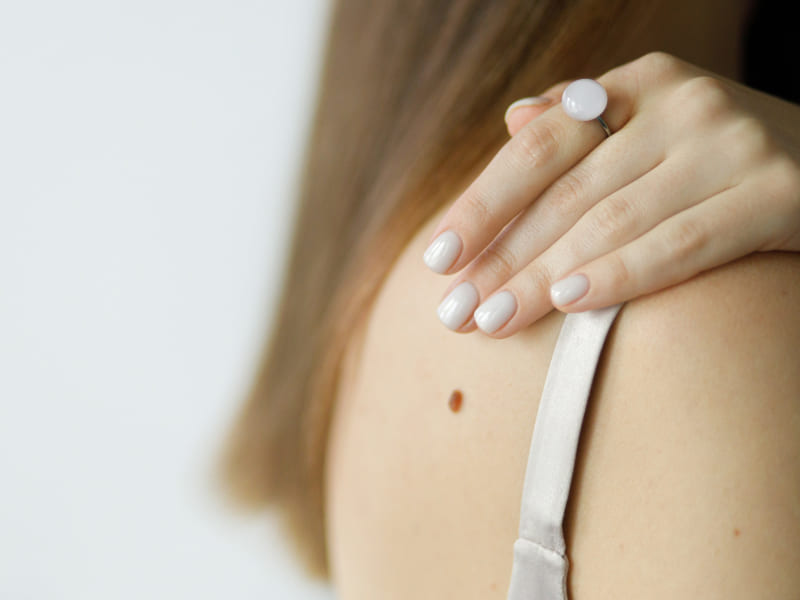
Also known as Nevus. Normal moles are symmetric and have one color and a shape that is round or oval. They also look the same from month to month. Most moles can be perfectly normal and never change into melanoma. People often want to know how they can tell a mole from a melanoma. Here is a general rule for atypical moles and melanomas, known as ABCDE of Melanoma
Melanoma
Asymmetry
One half is unlike the other half.
Border
Irregular, scalloped or poorly-defined borders.
Color
More than one color in the same mole (tan, brown, black, red, white, even blue).
Diameter
Usually greater than 6mm (size of pencil eraser).
Evolution
Also known as Nevus. Normal moles are symmetric and have one color and a shape that is round or oval. They also look the same from month to month. Most moles can be perfectly normal and never change into melanoma. People often want to know how they can tell a mole from a melanoma.
Melanoma—If you see a mole or new spot that has any of the ABCDE of melanoma, see a dermatologist immediately. If caught early, melanoma can be cured. Without treatment, melanoma can spread and be deadly. At Roseville Dermatology, we recommend and perform full body skin exams for all of our patients. Patients with a history of skin cancer should have complete skin exams regularly by a dermatologist and report any changes in moles or lesions.
Here is a general rule for atypical moles and melanomas, known as ABCDE of Melanoma
Asymmetry
One half is unlike the other half.
Border
Irregular, scalloped or poorly-defined borders.
Color
More than one color in the same mole (tan, brown, black, red, white, even blue).
Diameter
Usually greater than 6mm (size of pencil eraser).
Evolution
A mole that looks different than the rest OR is changing in size, shape, or color.
Other types of Moles
Moles in children—It is normal for new moles to develop in young children and teenagers. Moles will grow as the child grows and some will darken or become raised or develop hairs. These signs are expected and seldom a sign of melanoma.
Most moles do not require treatment. A dermatologist will remove a mole that is suspicious for cancer, bothers the patient, or for cosmetic reasons (if cosmetic, not covered by insurance). A mole can be removed by shave removal, punch removal, or surgical excision, depending on the size and location. We do NOT freeze moles.
Schedule An Appointment
If you’re looking to remove or evaluate moles for safety and skin health, we’re here to help. Call our office or book an appointment online today.